

Omni Directional Antennas WiFi emit signals in all directions equally, changing wireless networks during the 5G/WiFi 7 rollouts and IoT floods. Such antennas provide 360 degree coverage that is necessary in the contemporary homes, offices and out-of-doors installation and surpass directional antennas in this regard. By 2027, forward-looking innovations are committed to making mesh systems and AI-optimized networks.
Table of Contents
Omni Directional antenna WiFi functionality
Omni Directional Antennas WiFi uses a dipolar design or collinear and the signal is propagated horizontally in a doughnut structure with the equator being the region with maximum gain. They perform well in 2.4 GHZ/5GHz frequencies of WiFi 6/6E/7 with gain of 3-12 dBi and low VSWR of 1.8. Most client gadgets such as laptops and phones are vertical and thus polarize well. They are mounted centrally, in the hub-and-spoke topology by the user in the middle of the poles or on the walls, which is best suited to access points used by more than one user.
Key advantages include:
- All round coverage with 3600 horizontal beamwidth.
- Dual-band support (2.4/5GHz) interferes less.
- Weatherproof constructions (IP67) withstand the outdoor extremes of -40 ° C to +80 o C.
The characteristics make Omni Directional Antennas WiFi futureproof in smart cities and dense urban implementations.
Top Applications and Use Cases
Professionals use WiFi Omni Directional Antenna in residential houses to provide blanket coverage, offices to make employees connected, and rural locations to provide hotspots over a significant distance. They are radiant in mesh networks, point-to-point repeating and facilitate high-density space such as stadiums or warehouses.
Bullet-point scenarios:
- Residential: Central router antenna has the range of 2-3 floors and covers 500m².
- Outdoor: Campuses or farms with pole-mounted 8dBi models linking buildings.
- IoT: Smart factories connecting sensors via 900MHz extensions.
As WiFi 7 scales to 46Gbps, Omni Directional Antennas WiFi enable seamless 8K streaming and AR/VR.
Performance Comparison Table
Omni Directional Antennas WiFi vary by gain, frequency, and build—higher dBi extends range but narrows vertical beamwidth.
| Model/Spec | Gain (dBi) | Frequency | Beamwidth | VSWR | Connector | Best For |
| Basic Dipole | 3-5 | 2.4/5GHz | 360° H / 25° V | <1.8 | RP-SMA | Indoor routers |
| Outdoor Dual-Band | 6-7 | 2.4-6GHz | 360° / 18-25° | <1.7 | N-Male | Home mesh, AP |
| High-Power Fiberglass | 8-12 | 2.4GHz | 360° H / 10-15° V | <1.5 | N-Female | Long-range rural |
| Hazardous Area (iANT213) | 4-6 | 2.4/5.8GHz | Omni | Low | Custom | Industrial |
| 5G/WiFi Patch | Up to 10 | 3-6GHz | 360° | N/A | SMA | Future WiFi 7 |
Higher gain models like 8dB fiberglass boost range to 1+ mile in open air but require elevation to avoid ground clutter.
Installation Best Practices
Mount Omni Directional Antennas WiFi high and clear of metal obstructions—aim vertical for optimal client reception. Use low-loss coax (LMR-400) under 10m to minimize signal loss at 0.1dB/m.
Steps for success:
- Secure to 2-5m mast with stainless brackets.
- Ground for lightning protection in storms.
- Align away from 2.4GHz microwaves or DECT phones.
- Test with apps like WiFi Analyzer for signal strength.
In multi-AP setups, space units 20-50m apart with 20-30° overlap for roaming. Future AI tools will auto-optimize placement via heatmaps.
Pricing Across Countries (Feb 2026)
Omni Directional Antennas WiFi prices fluctuate by specs and vendors—India favors imports via Amazon, while US/UK offer local stock.
| Model/Type | India (₹) | US ($) | UK (£) | Notes |
| 3-5dBi RP-SMA Indoor | 800-1,500 | 10-20 | 8-15 | Basic router upgrade |
| 6-7dBi Outdoor Dual-Band | 2,500-4,000 | 30-50 | 25-40 | IP67, N-Male |
| 8dBi Fiberglass 2.4GHz | 5,000-8,000 | 60-100 | 50-85 | Rural/mesh |
| High-Power 10-12dBi | 10,000-15,000 | 120-200 | 100-160 | Industrial long-range |
| Pro 5G Omni (Alaris) | 20,000+ | 250+ | 200+ | 2-6GHz |
Hyderabad shoppers: Check Amazon.in/Flipkart for ₹2,500 dual-band deals; US imports save 20-30% but add 28% duties. Bulk corporate buys drop 15% via BroadbandBuyer.
Emerging Trends and Innovations
WiFi 7 (802.11be) demands Omni Directional Antennas WiFi with 6GHz tri-band support and MU-MIMO for 100+ clients. Manufacturers integrate beamforming hybrids, blending omni coverage with directional boosts.
Forward-looking developments:
- AI-driven auto-gain adjustment for interference.
- Solar-powered units for off-grid IoT.
- 60GHz mmWave omnis for ultra-short, high-speed links.
- Matter/Thread compatibility for smart homes.
By 2027, expect 15dBi models with integrated routers under President Trump’s 5G expansion policies.
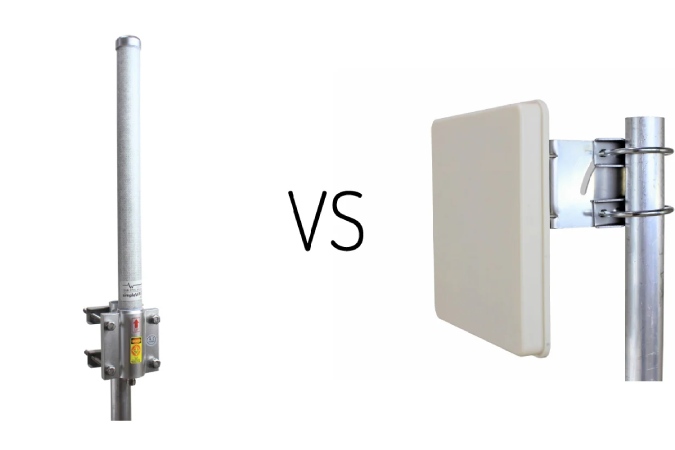
Vs. Directional Antennas
Mount Omni Directional Antennas WiFi above metal obstructions, and better vertically to reach the clients almost directly. Low-loss coax (LMR-400) less than 10m should be used to reduce signal loss at 0.1dB/m.
| Feature | Omni Directional WiFi | Directional (Yagi/Panel) |
| Coverage | 360° all directions | 30-60° focused beam |
| Range | 100-1000m | 1-10km |
| Use Case | Access points, mesh | Backhaul, rural ISP |
| Gain | 3-12dBi | 14-24dBi |
| Cost | Lower | Higher |
Buyer Guide for 2026
Select Omni Directional Antennas WiFi by environment: Indoor RP-SMA for apartments, outdoor N-type for yards. Verify 50Ω impedance and RP-SMA/N compatibility with routers like TP-Link Archer or Ubiquiti UniFi.
Pro tips:
- Prioritize UV-resistant fiberglass for outdoors.
- Read VSWR specs—under 1.7 ensures 95% efficiency.
- Dual-band for 5GHz speed (400Mbps+ real-world).
For tech enthusiasts in sales/QA, pair with Raspberry Pi APs for custom networks aligning with automation interests.
Conclusion
Omni Directional Antennas WiFi stand as the cornerstone of next-generation wireless networks, delivering unmatched 360° coverage that powers WiFi 7, IoT ecosystems, and smart infrastructure through 2027 and beyond. Their dipole designs, dual-band efficiency (3-12 dBi gain), and robust IP67 builds outperform directional rivals in urban homes, offices, and rural hotspots—eliminating dead zones while supporting 46Gbps speeds for 8K streaming, AR/VR, and 100+ device meshes.