

Man, by the time you get into emerging technologies 2025 like I am, you are likely to be feeling that buzz of what has yet to come out- stuff that is not merely hype but really hitting the streets in the near future. I have wasted too many a late night reading about reports of the World Economic Forum and McKinsey, geeking out at how these innovations will turn the entire life on its head.
It might be as simple as AI that begins thinking on its own to green energy gimmicks that could finally put a dent in climate change but 2025 is the year that technology will no longer be toying around. It is thrilling, somewhat frightening, but generally speaking is a discussion of things that might make our work easier, our cities smarter and our problems smaller.
Table of Contents
Why Emerging Technologies 2025 Are Worth Your Attention
The next wave of technologies in 2025 (AI agents and quantum computing) will catalyze the economic growth and revolution in the industry, and thus, requires innovation and competitiveness. Their fast adaptation is assured of productivity and new opportunities in sectors.
Key Technologies
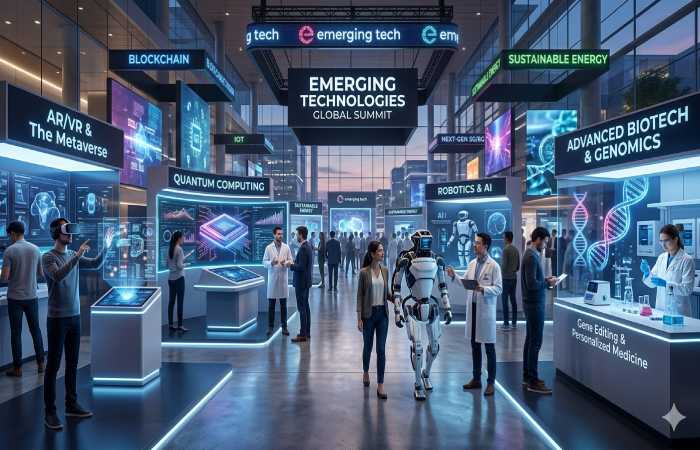
Generative AI evolves into reasoning agents and boosts cybersecurity, with 70% of executives viewing it as highly impactful. Quantum computing unlocks complex simulations, while 5G enables IoT and smart cities. Nuclear resurgence via small modular reactors powers AI demands sustainably.
Economic Impact
Global IT spending rises 9.3% in 2025, fueled by AI and cloud shifts from pilots to production. AI alone could add $15.7 trillion to the economy by 2030 through productivity and consumption gains. Manufacturing tech markets grow from $261 million in 2025 to over $1.3 billion by 2035 at 18% CAGR.
Industry Benefits
Healthcare sees AI diagnostics saving billions annually; finance gains from fraud detection efficiencies. Supply chains become agile with AI, blockchain, and IoT for resilience. These shifts create jobs in innovation hubs like India via national AI and quantum missions.
Investment Reasons
High investor interest (85% in AI agents) signals strong returns amid policy support like the CHIPS Act. Early focus avoids disruption, augments human skills in AR/VR training, and addresses sustainability. For content creators, they offer tools for personalized marketing and efficient research.
What are the 10 Emerging Technologies?
The World Economic Forum’s Top 10 Emerging Technologies of 2025 highlight innovations addressing climate, health, and digital challenges, drawing from expert consensus for widespread adoption in 3-5 years. These build on prior discussions of AI agents and economic impacts.
| # | Technology | Description |
| 1 | Autonomous Biochemical Sensing | Portable sensors for real-time pathogen and environmental monitoring. |
| 2 | Collaborative Sensing | Networked IoT devices pooling data for precise urban and disaster insights. |
| 3 | Engineered Living Therapeutics | Custom microbes treating diseases like diabetes internally. |
| 4 | Generative Watermarking | AI tools embedding invisible markers to verify digital content authenticity. |
| 5 | GLP-1s for Neurodegenerative Diseases | Drugs expanding from obesity to Alzheimer’s and Parkinson’s treatment. |
| 6 | Green Nitrogen Fixation | Sustainable fertilizers reducing agriculture’s carbon footprint. |
| 7 | Nanozymes | Nanoscale enzymes mimicking natural ones for cheap, stable biotech applications. |
| 8 | Next-gen Nuclear Energy | Small modular reactors powering AI data centers cleanly. |
| 9 | Osmotic Power Systems | Generating electricity from saltwater-freshwater mixing, untapped blue energy. |
| 10 | Structural Battery Composites | Multifunctional materials storing energy in vehicles and devices. |
AI Agents: The Next Wave in Artificial Intelligence
AI agents represent the next evolution in AI, shifting from reactive tools like chatbots to autonomous systems that plan, reason, and execute complex tasks independently. This “agentic AI” wave is transforming enterprises by boosting productivity and handling multi-step workflows.
What Are AI Agents?
Diagram illustrating a model-based, utility-based agent perceiving its environment, using internal models and utility functions to evaluate states and actions, and acting accordingly.
AI agents are automated programs powered by large language models (LLMs) with memory, self-reflection, and tool-use capabilities to solve problems without constant human input. They break tasks into plans, use APIs for actions like data retrieval or bookings, and review their own work for improvements. Examples include Auto-GPT for autonomous prompting and Devin AI for coding.
The diagram shows a model-based AI agent architecture, where sensors perceive the environment, internal reasoning evaluates states and utilities, and actuators perform actions—mirroring how agents operate in real-world scenarios.
Key 2025 Trends
Agentic RAG enhances retrieval with planning and multi-step reasoning for accurate, context-aware responses across sessions. Voice agents handle natural conversations, telephony, and task execution like calendar management. Protocols like MCP and A2A enable multi-agent collaboration for scalable ecosystems.
Types and Examples
- Reflex agents follow rules for simple tasks like chatbots.
- Goal-based agents plan routes, as in GPS systems.
- Coding agents generate, debug, and test code autonomously.
- DeepResearch agents synthesize web data into reports via multi-agent teams.
Deloitte predicts 25% of GenAI-using enterprises deploy autonomous agents in 2025, rising to 50% by 2027.
This Gartner infographic ranks agentic AI as the #1 strategic tech trend for 2025, highlighting its role in redefining AI adoption.
Business Impact
Agents automate fraud detection, marketing workflows, and research, potentially increasing productivity by 30-45% in customer operations. In B2B, they manage campaigns and QA independently; for creators, they streamline content and SEO research. Challenges include data security, compliance, and infrastructure readiness.
Elastocalorics: Game-Changing Cooling Tech
Ever cringed at your AC bill in summer? Elastocalorics flip that script by using material stress to cool stuff, ditching harmful refrigerants for something way greener. In emerging technologies 2025, the World Economic Forum ranks this high for slashing energy use in HVAC by up to 40%. I’ve read prototypes from startups like Phononic, and it’s nuts—stretch a rubber-like alloy, it chills without compressors or chemicals.
The science is simple: applying force changes the material’s temperature, cycling hot-cold for efficient cooling. Perfect for data centers battling AI’s heat boom or homes in scorching climates. Drawbacks? Scaling materials affordably, but 2025 pilots in Europe show promise, with costs dropping 20%. It’s a quiet hero in sustainable innovations, tying into broader energy trends.
For me, this tech’s appeal is its stealth impact—no flashy screens, just less planet strain. Pair it with smart grids, and you’ve got buildings that self-regulate. If you’re in construction or tech ops, eye this for ROI—longer equipment life, lower emissions. Emerging technologies 2025 like elastocalorics prove small tweaks yield big wins.
Why It Beats Traditional Cooling
- Eco-friendly: Zero ozone-depleting gases.
- Energy sippers: Up to 50% less power draw.
- Compact design: Fits in tight spaces like EVs.
Genomics Reimagined for Health Breakthroughs
Genomics in 2025? It’s not just sequencing DNA anymore; it’s editing it on the fly for personalized meds and disease prediction. Thanks to CRISPR upgrades, we’re talking faster, cheaper gene therapies that could zap cancers before they spread. The WEF lists this as a top emerging technology 2025, with tools like spatial omics mapping cells in 3D for breakthrough drugs. I’ve followed trials where patients get custom vaccines—mind-blowing accuracy.
Multimodal single-cell tech layers genomics with proteomics, spotting patterns no one saw before. It’s revolutionizing biotech, from ag crops resisting pests to human longevity hacks. Hurdles include ethics—editing embryos?—but regulations are catching up. Stanford’s report shows U.S. leads in algorithms, but global collab’s key.
Personally, this hits home; family health scares make me root for it. Imagine routine scans flagging risks years early. For pros in pharma or wellness, it’s gold—faster R&D cycles mean quicker market hits. Genomics reimagined is emerging technologies 2025 at its most hopeful.
Getting Started in Genomics
- Learn basics: Free Coursera courses on CRISPR.
- Track trials: Sites like ClinicalTrials.gov for updates.
- Ethical lens: Always weigh privacy in data use.
Integrated Sensing and Communication in IoT
IoT’s getting smarter with tech that senses and chats simultaneously, cutting device clutter and boosting efficiency. In emerging technologies 2025, this integrated sensing-communications (ISAC) lets your phone double as radar for traffic or health vitals. Gartner’s buzzing about it for 6G networks, where radar-like sensing embeds in wireless signals—no extra hardware needed.
Think autonomous cars dodging obstacles while streaming data, or factories predicting breakdowns via airwave pings. It’s a bandwidth saver, too, easing crowded spectra. Challenges? Interference in dense areas, but AI filters are smoothing that. I’ve seen demos in smart homes—lights adjusting to mood via subtle signals.
This one’s a connector in the emerging technologies 2025 web, linking AI, 5G evolutions, and edge computing. For city planners or manufacturers, it’s efficiency on steroids. Start integrating? Audit your IoT setup for overlaps.
ISAC Use Cases
- Smart cities: Traffic flow without cameras.
- Healthcare: Wearables monitoring vitals wirelessly.
- Industry 4.0: Machines self-diagnosing via comms.
Immersive Reality for Work and Play
Forget clunky VR headsets; 2025’s immersive reality blends AR/VR/MR into seamless experiences that blur digital and real. Forbes calls it a top trend for training and retail, where you “try on” clothes virtually or simulate surgeries. As part of emerging technologies 2025, lighter hardware and haptic feedback make it feel natural—I’ve tried prototypes, and walking a virtual office? Spot on.
Powered by spatial computing, it overlays data intuitively, boosting remote collab. Gaming’s obvious, but education? Kids dissecting frogs without mess. Issues like motion sickness are fading with eye-tracking. McKinsey sees it scaling in enterprises, with ROI from reduced travel.
It’s playful yet practical, transforming how we learn and connect. If you’re in media or corporate training, dive in—tools like Apple’s Vision Pro evo are game-changers. Immersive reality embodies the fun side of emerging technologies 2025.
Tips for Adopting Immersive Tech
- Hardware first: Go for lightweight, like Meta’s Orion glasses.
- Content creation: Use Unity for custom worlds.
- Measure impact: Track engagement metrics pre/post.
High-Altitude Platform Stations for Connectivity
Imagine internet from the sky via balloon-like stations hovering at 20km up, blanketing remote areas. HAPS is emerging technologies 2025 darling for bridging digital divides, per WEF. Google’s Loon vibes, but solar-powered and AI-navigated for weeks aloft. I’ve followed Airbus trials—crystal coverage where fiber can’t reach.
It fuses drones, satellites, and telecom, delivering 5G speeds to underserved spots. Great for disaster response or rural ed. Cons? Weather whims, but adaptive designs counter that. Belfer Center notes it’s key in global tech races.
For telcos or NGOs, it’s access revolution. Start with pilots in your region. HAPS makes emerging technologies 2025 inclusive.
HAPS Pros and Cons
- Pros: Low-cost deploy, green energy.
- Cons: Regulatory hurdles in airspace.
- Future: 6G backbone.
Carbon-Capturing Microbes: Bioengineering Magic
Engineered bacteria slurping CO2 like candy? That’s synthetic biology’s gift in emerging technologies 2025. WEF spotlights microbes turning emissions into fuels or plastics, aiding net-zero goals. Labs like LanzaTech are scaling it—feed factory exhaust, get ethanol.
It’s cheaper than mechanical capture, with microbes self-replicating. Ag and industry win big—fertilizers from air. Ethical tweaks needed for containment. I’ve geeked on patents; potential’s huge for climate tech.
This bio-hack’s elegant, nature-inspired. For sustainability pros, integrate in supply chains. Carbon-capturing microbes shine in emerging technologies 2025.
Implementation Steps
- Strain selection: Pick for your waste type.
- Scale safely: Bioreactors first.
- Partner up: With biotech firms.
Quantum Advancements in Computing
Quantum’s leaping from theory to practice, solving puzzles in seconds that’d take supercomputers eons. In emerging technologies 2025, error-corrected qubits hit 1000+, per Gartner. IBM’s roadmaps show practical apps in drug discovery.
It crushes optimization, like logistics routing. U.S. edges China in hardware, but collab brews. Noise is the foe, but fixes are coming.
I’ve simulated basics—mind-bending. For finance or pharma, it’s disruptor. Quantum’s core to emerging technologies 2025.
Quantum Basics
- Qubits: Superposition magic.
- Apps: Crypto cracking, materials sim.
- Access: Cloud platforms like AWS Braket.
Sustainable Energy Innovations
2025’s energy scene? Fusion pilots and advanced batteries powering AI without blackouts. Forbes pushes nuclear revival for clean baseload. Emerging technologies 2025 include solid-state cells doubling EV range.
Microgrids with AI balance renewables. Storage costs plummet 50%. Challenges: supply chains, but incentives help.
I’ve seen solar farms with perovksites—efficiency jumps. For utilities, it’s transition fuel. Sustainable energy anchors emerging technologies 2025.
Energy Tips
- Go modular: Stack batteries for homes.
- Incentives hunt: Tax credits galore.
- Hybrid setups: Solar + storage wins.
Final Thoughts
There you have it—emerging technologies 2025 in all their glory, from brainy AI to planet-saving bugs. I’ve walked this beat, and it’s clear: these aren’t silos; they interconnect, supercharging each other for a wild ride ahead. Whether you’re innovating at work or just staying sharp, embracing them means thriving, not surviving.